Sunday, November 13, 2011

How do you like your pork?

Hornado de Chancho in Cuenca, Ecuador
Ecuadorans are proud of their “comidas typicas” (typical foods) which vary by region – coast, highlands, and the Amazon. The favored regional pork dishes are examples of comidas typicas. On the coast and in the highlands, the pork dish is called Hornado de Chancho. The coastal version of Hornado de Chancho is a pork leg that is cooked in the oven.

In Cuenca, which is in the highlands, the Hornado de Chancho is the entire pig cooked whole. The crisp outer skin - I think they call it “cascaritas” - is a delicacy; a blow-torch cooking apparatus is used to crisp the skin and layers of meat. In the market, the vendors use their hands to pull the meat from the whole pig.

In other areas of the highlands, the regional pork dish is called “Fritada.” The Fritada is cooked in a large pan over an open fire. They start out boiling the pork and pork fat in water, but eventually the water evaporates and the pork is fried in its own fat with salt, white onions, and garlic.

The beginnings of a Fritada meal.
Pork and pork fat in boiling water.


We enjoyed this meal of fritada with friends in Pallatanga.
 
A plate of fritada, platano, choclo, potatoes with onion sauce, and habas.

The fritada is traditionally served with a large white corn called choclo, potatoes with an onion sauce that is made with bread, milk, butter and salt, and cooked habas (I think this is a type of fava bean).  Mike and I had a wonderful fritada meal with friends in Pallatanga. I’m not sure where the pork came from, but we watched Marietta, the cook, prepare the meal from start to finish, and we decided that the pork was fried enough that it would be safe to eat. The meal was delicious!
Fritada in Mindo, Ecuador
These fritada stands are typical of eateries that you see on the sides of roads throughout ecuador. Some of the stands may have a plastic table or two for customers to sit and enjoy their meal.


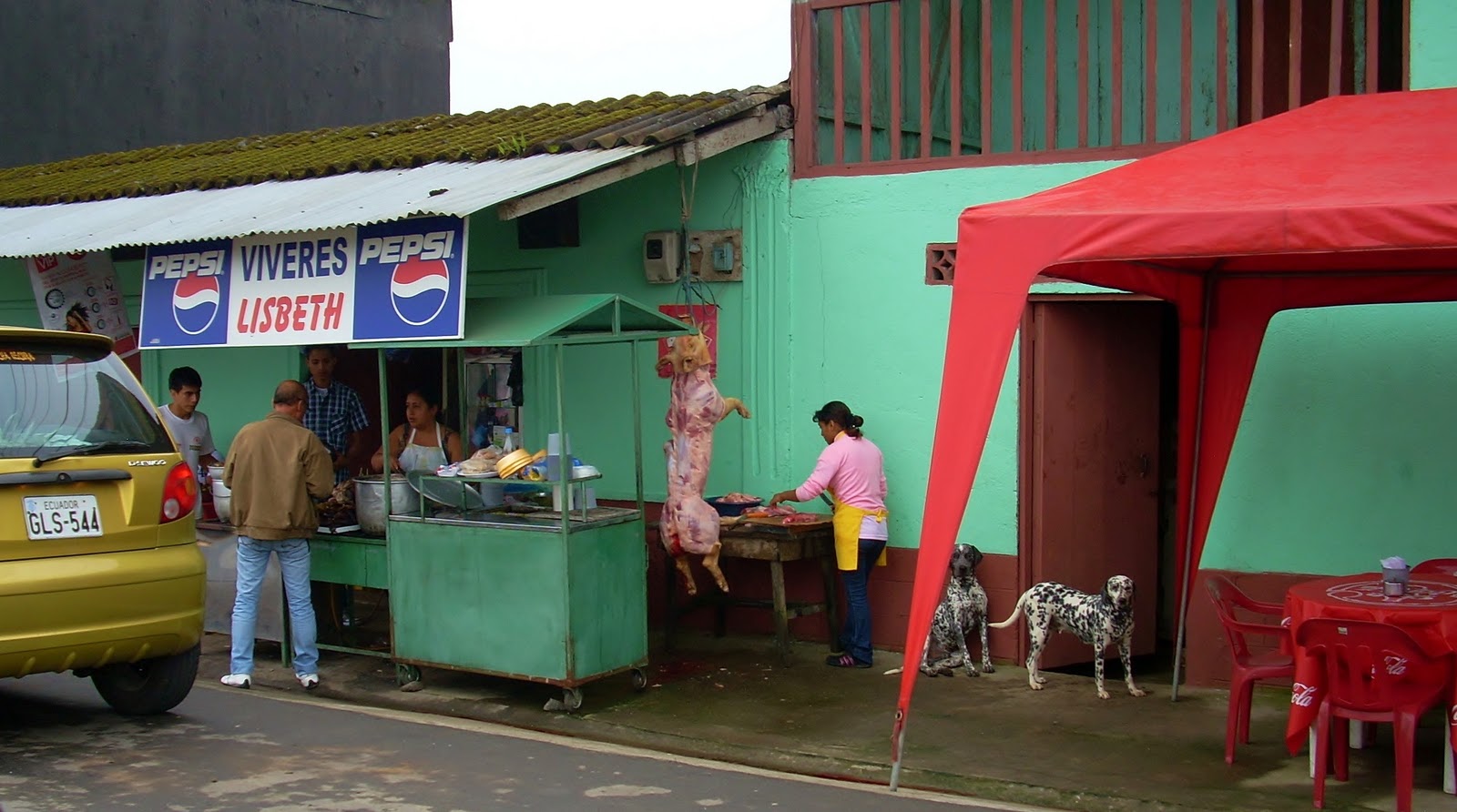
This fritada stand is somewhere on the road between Mindo and Guayaquil.
Sometimes the stands will hang the whole pig.


Monday, October 31, 2011

Tricimotos and Carretas


This driver gives his children and their friends a ride home from school in  his tricimoto.
Tricimotos (motor taxis) are a common mode of trasportation in the poor sections of the city and in the towns and villages in the rest of the country. In the city, passengers get of the bus on the highway (apparently a bus will drop off and pick up passengers anywhere along the road), and then take a tricimoto or a carreta (the pedal-powered version) into the barrios where the roads are impassible to busses and in some places cars. In some of the more popular locations, such as the main entrances into the barrios, the tricimotos line up along the side of the highway like a cab line. The law prohibits the tricimotos from driving on the main roads, but like many other regulations here, there are few or no resources to enforce the law. 

Tricimotos on the  Main Street in a Fishing Village, Puerto Lopez

Tricimotos Waiting for School Dismissal on Isla Trinitaria
 

Children from a Public School In Guasmo Get a Ride Home in a Carreta


This tricimoto is in the front yard of a school in an invasions area.
The school and houses in this area have electricity, but no running water.


Saturday, October 29, 2011

Mrs. Foreigner


Mike and I frequently order a pizza  from a Domino's Pizza place that's close to our apartment. With a coupon, we can get an extra large pizza with pepperoni, breadsticks, a big salad, and a 1.5 liter bottle of coke for $20.99. The pizza's really good - about the closest thing we've had to eat in Ecuador that tastes like something we would eat in the states. I haven't quite mastered phone conversations in Spanish yet, so I always order in person. Even in person they have a difficult time with my first and last names. Recently, the clerk didn't ask me for my name when I ordered. When I went to pick up the pizza, I told him that he forgot to ask for my name. He replied that he remembers me. Curious about how he spelled my name, I looked at the receipt... SRA EXTRANGERA... Mrs. Foreigner!

Thursday, October 20, 2011

Forgiveness

Escuela Fiscal Monte Sanaí is located in an invasions area in Guayaquil.
This septimo de basica (6th grade) classroom has 78 students.

I had the opportunity to visit several public schools in a very poor area of Guayaquil. Areas of the city such as the one where the schools are located are commonly refered to as "invasiones"... invasions. In search for a better life, thousands of people who have nothing move into the city and build communities on property that doesn't belong to them. Living condtions are poor, and the area is dangerous. This message was beautifully handcrafted on a bulletin board in a kindergarten classroom of a school within the invasiones area.


My interpretation...
“Forgiveness”
Forgiveness means that the guilty one, in the end,
is better than his actions suggest.
Forgiveness has the power to heal.
Humans sometimes forgive,
but God always does.

Thank you, Tom, for pointing it out to me.

Primero de basica (kindergarten) students were taking a written test.


More Students in the Septimo de Basica (6th Grade) Classroom


Sunday, October 16, 2011

Strawberries in Pallatanga


We spent last weekend in Pallatanga with a member of the FUNEAP board, Lorena, and her family. Lorena's parents have a country house on the Rio Coco on the outskirts of the town. Pallatanga is a small farming community situated in a valley in the Chimborazo province in the Andes. It's about a 3-hour drive southeast from Guayaquil. The roads from Guayaquil to Pallatanga were in pretty good condition except for one landslide area (which from a distance I thought was a rock quarry... but then we had to drive right through it!).  


A truck, already loaded with beans, stopped for crates
of strawberries that were stacked under the awning of
the house in the background, and  then continued down
the mountain towards town.
 
On Saturday afternoon we went out in search of food, which is how I think the local people spend much of their time when they're not working. Other than a meat shop, a bakery, and a little tienda where it looked like you could buy some odds and ends like eggs, butter, and perhaps a piece of meat hanging from a hook, there are no grocery stores in town. Instead, people set up stalls in the streets where they sell fruits, vegegables, and herbs. Other staples such as cheese, milk, and eggs are sold from the farms or vendors' houses.

Mami and Raúl bargained for strawberries.


Although the little children were a bit shy, they appeared to be as
curious about us as were were about them.

 It's strawberry season in Pallatanga, so we drove up a gravel road into the mountains for a scenic outing and in search of strawberries. I have heard strawberries called both "frutilla" and "fresa," and while in Pallatanga I learned that frutilla are a smaller strawberry and fresas are a larger and sweeter strawberry. We drove past several strawberry fields until we saw a woman working in a field with some children playing nearby. She motioned for us to come up her road, and this is where Mami, Lorena's mother, bargained for our strawberries. She bought six wooden crates of frutillas for $4 a crate - crate included; the crate held at least four quarts of strawberries. In Johnson City, I think the deposit for the crate itself is $5-10 dollars.

They may not have hot water or indoor plumbing, but they do have cell phones and technology.
The child in the center took a break from strawberry picking to use an electronic device.


The people who live in the mountains have had water and electricty for the past five to ten years, but most live in rather primitive conditions. In preparation to go to town, the woman who sold us the strawberries washed up in a large galvanized bucket that was situated just outside the door of her concrete house. The house across the road, typical of those found in the highlands, was constructed of wood planks and a crude metal roof. The children were dirty, although they told Lorena that they take a bath every day. Despite the dirt, I think they are beautiful, and I wonder if they are happy in their innocent ignorance of the modern world (if that's what we can call Cuenca and Guayaquil) that is not so far away.  They will have a hard life, as they are expected to help the family work in the fields at a young age.


Tuesday, September 27, 2011

Juramento a la Bandera - Flag Swearing Ceremony


Every student kneels to kiss the flag in the Juramento a la Bandera.
Today is Día de la Bandera Nacional (National Flag Day) in Ecuador. On this day, as declared by Ecuadoran  law, students swear to the flag with a kiss that symbolizes their love of and allegiance to Ecuador. At Colegio Americano, the 6th course students (seniors) participate in the Juramento a la Bandera with a procession and a kiss in a solemn ceremony. The ceremony also includes recognition of the highest achieving 6th course students with diplomas of honor.

Sixth course student Xavier Torres
is the honored bearer of the Ecuadoran Flag.
The 5th course students (juniors) who have high academic achievement receive the privilege of carrying the historical flags of Ecuador.


My translation of the "Group Swearing to the Flag"
"Swear by God and your honor, before the flag of Ecuador, to faithfully fulfill your civic duties, according to the Constitution and laws. Do you swear to be worthy citizens, lovers of the Fatherland, to give your lives if necessary, in defense of the country and its institutions?
If you so swear, the country will reward you, otherwise you will be judged."

Adrean, Lori, Mike, Nicole, and Joselyn pose for a photo before the ceremony.

Sunday, September 25, 2011

Humpback Whales

(You can click on the pictures to enlarge them.
Use the back arrow to return to the original size.)

From June through October the Humpback whales follow the cold Humboldt current up the South American coast from Antartica to feed on the krill and bear their young. We took a CercaPez excursion to see the whales the first weekend in August. We stayed at the Hosteria Mandala in Puerto Lopez, and they arranged the tour for us. The tour cost $37 per person, and included whale sightings, a hike on the Isla de la Plata, and snorkeling at the island.

Of course, whale sightings aren’t guaranteed, but we saw lots of them on our trip. They were amazing!
The tour agency is located on the main street of Puerto Lopez. Although we got a ride there in a tour guide's pick-up truck, most people catch a ride through town in the little mototaxis.


They fed us tuna and cucumber sandwiches on the boat. I was wondering if they came from this vendor who was making and  selling his sandwiches in front of the tour agency.


The tour boat we went on held about 14 people. It was similar in size to the boats nearest to the shore. No match for a whale!
 
A view of the coast from the boat.


Hello! An adult and young whale waving their fins.


The End...
tail


Saturday, September 24, 2011

Computer Troubles

I've had computer troubles! First, my laptop screen started to malfunction. It was just a few extra vertical lines at first, but it quickly turned into a flashing mess. We tried to get a replacement screen, but nobody in Ecuador had a compatible screen. I had to buy a new computer. I didn't think that would be too much of a problem, and it wouldn't have been if I was o.k. with a Spanish  language operating system. I can get around pretty well with the Spanish menus, but the Spanish keyboard and Spanish only spell check would have been a problem. After some searching, we were able to locate an English operating system.

Being without a computer set me back a little, both in my work and my blog. I'm starting to get caught back up, and I have a lot to post! We've seen whales, blue footed boobies, and the Galapagos.

Whale pictures are coming soon.